
Description
Pulsar Symbion LRF DXT50 – Premium Multispectral Thermal and 4K Digital Binoculars
Advanced thermal detection and digital observation in one device
The Pulsar Symbion LRF DXT50 combines high-definition thermal imaging, 4K digital observation, night vision and precise laser distance measurement in a single multispectral binocular system.
Built for hunters, wildlife enthusiasts, conservation professionals and demanding outdoor users, the Symbion LRF DXT50 allows observers to detect heat signatures, examine visible details and measure distances without switching between separate optical devices.
At the centre of the system is a high-performance 1280×1024 thermal sensor with 12 µm pixel pitch, supported by a fast 50 mm F1.0 germanium objective lens. Alongside the thermal channel, a 3840×2160 4K CMOS sensor delivers detailed digital observation in daylight and twilight, with infrared-assisted night vision for darkness.
The integrated 1500 m laser rangefinder, electronic image stabilisation and multispectral DUO mode help the user examine distant subjects, maintain visual awareness and make more informed observations.
With a thermal detection range of up to 2300 metres, a wide thermal field of view and a weather-resistant magnesium alloy body, the Symbion LRF DXT50 is engineered for extended observation across forests, farmland, open countryside and mixed terrain.
1. High-Resolution 1280×1024 Thermal Imaging Sensor
Outstanding thermal detail for demanding observation
The Pulsar Symbion LRF DXT50 features an advanced, uncooled thermal microbolometer with a resolution of 1280×1024 pixels.
This high sensor resolution provides 1,310,720 individual thermal detection pixels, allowing the device to capture detailed temperature information across the observed scene.
Compared with a conventional 640×480 thermal sensor, the 1280×1024 detector contains approximately 4.27 times as many pixels.
This increased thermal resolution provides significant advantages when examining distant animals, monitoring movement or observing environments containing multiple heat sources.
Practical benefits include:
- Greater thermal detail across large observation areas.
- Improved definition of animal outlines and body shapes.
- Better retention of visible detail when increasing digital magnification.
- More effective separation of nearby heat signatures.
- Improved examination of distant targets under suitable conditions.
- Detailed thermal observation in forests, fields and open landscapes.
A high-resolution thermal sensor is particularly valuable during extended observation, when the user needs to examine a detected heat source rather than simply establish its presence.
The Symbion DXT50 is designed to provide that additional level of thermal information.
12 µm pixel pitch and advanced thermal sensitivity
The thermal detector uses a 12 µm pixel pitch, combined with a sensor NETD rating below 35 mK.
NETD stands for Noise Equivalent Temperature Difference. It describes the detector’s ability to distinguish small temperature differences within an observed scene.
A lower NETD value generally indicates greater sensitivity to subtle temperature variations.
The DXT50 also features a system NETD rating below 20 mK, reflecting the thermal performance of the complete imaging system.
These specifications help the binoculars display meaningful temperature differences between animals, vegetation, soil and other objects.
This becomes especially important when environmental conditions reduce natural thermal contrast, such as during humid weather, light rain or periods when surrounding surfaces have similar temperatures.
Thermal performance still depends on weather, target size, distance and environmental conditions.
2. Powerful 50 mm F1.0 Thermal Objective Lens
High-performance optics for long-distance thermal observation
The Symbion LRF DXT50 features a 50 mm F1.0 thermal objective lens, designed to collect infrared radiation efficiently and direct it towards the high-resolution thermal sensor.
The F1.0 aperture is an important component of the optical system, helping maximise the thermal energy reaching the detector.
This supports detailed imaging and effective detection when temperature differences are relatively small.
The combination of a 50 mm objective, 12 µm pixel pitch and 1280×1024 detector delivers a useful balance between magnification, field of view and thermal image detail.
2–24x thermal magnification
The thermal channel offers magnification from 2x to 24x.
At lower magnification, users gain a broader overview of their surroundings. This is particularly useful when searching woodland edges, scanning fields or monitoring moving animals.
Higher magnification allows closer examination of previously detected subjects and distant details.
The smooth digital zoom system enables progressive adjustments without forcing the user to switch between only a few fixed magnification settings.
Because magnification beyond the optical base level is digital, increasing zoom does not create additional sensor detail. The high native thermal resolution helps preserve useful information as magnification increases.
3. Wide 17.5° Thermal Field of View
Cover more ground with every scan
One of the most important characteristics of the Symbion LRF DXT50 is its wide thermal field of view.
The thermal channel provides a horizontal field of view of 17.5°, equivalent to approximately 30.7 metres at a distance of 100 metres.
This allows the observer to monitor a relatively broad section of terrain without constantly repositioning the binoculars.
A wide field of view is especially useful when:
- Searching for animals across woodland clearings.
- Monitoring several subjects within the same area.
- Following moving wildlife.
- Scanning agricultural land and open countryside.
- Observing mixed environments containing vegetation, trees and uneven ground.
- Maintaining awareness of the surrounding environment.
For example, at 100 metres, the stated field of view covers approximately 30.7 metres horizontally at base magnification. At 200 metres, the corresponding width is approximately 61.4 metres.
This provides an efficient starting point for systematic observation before increasing magnification to inspect a particular subject.
4. Thermal Detection Range Up to 2300 Metres
Detect distant heat signatures beyond normal visual observation
The Pulsar Symbion LRF DXT50 offers a manufacturer-rated thermal detection distance of up to 2300 metres for a deer-sized object.
The thermal channel detects infrared radiation emitted by objects and living subjects rather than depending on visible light.
This enables thermal observation during complete darkness, in daylight and in a range of challenging lighting conditions.
The device can assist in locating warm subjects against cooler surroundings, even when conventional optical binoculars provide limited visual information.
Its thermal imaging capabilities are particularly useful for:
- Locating wildlife across large fields.
- Detecting heat signatures around woodland edges.
- Monitoring animals at dawn and dusk.
- Scanning open countryside after sunset.
- Searching for warm objects in difficult lighting conditions.
- Supporting wildlife monitoring and conservation activities.
Understanding detection distance
Thermal detection and positive identification are different tasks.
The 2300 m rating describes the maximum specified detection distance for a deer-sized thermal target under suitable conditions. It does not guarantee that an observer can reliably identify an animal species at that distance.
Actual performance depends on the object’s size, temperature contrast, weather conditions, surrounding vegetation and the selected magnification.
Thermal imaging can reveal heat signatures through darkness and some atmospheric obscuration, but it cannot see through solid barriers, tree trunks, walls or dense opaque cover.
5. Integrated 4K CMOS Digital Imaging Channel
Detailed full-colour daytime observation
In addition to its thermal imaging system, the Symbion DXT50 incorporates an independent 3840×2160 4K CMOS digital sensor.
This digital channel provides detailed conventional imaging, helping observers examine the visible appearance of subjects detected through the thermal channel.
While thermal imaging highlights differences in temperature, the digital sensor captures visible scene information such as colour, patterns, textures and environmental details.
The two technologies complement each other.
The thermal channel helps locate subjects based on their heat signatures, while the digital channel assists with closer visual examination when sufficient light or infrared illumination is available.
50 mm digital objective lens
The 4K digital observation channel incorporates a 50 mm F1.8 objective lens.
Its optical system provides a horizontal field of view of approximately 5.8°, corresponding to 10.2 metres at 100 metres.
This narrower field of view is suited to examining individual subjects and features after a wider thermal scan.
6.5–26x digital magnification
The digital channel provides a magnification range of 6.5–26x, supporting detailed observation at increased viewing distances.
Users can examine distant objects, animal characteristics, vegetation and landscape details with the digital image.
The image quality achieved at higher magnification depends on available light, subject distance, atmospheric conditions and the amount of digital zoom applied.
The 4K sensor provides a high-resolution starting point for detailed digital observation.
6. Four Digital Observation Modes
Adapt the image to the available light
The Symbion LRF DXT50 provides four selectable digital observation modes to accommodate changing lighting conditions.
Day Color Mode
Designed for observation when sufficient daylight is available.
The digital sensor displays a full-colour image, helping the user examine natural colours and environmental details.
This mode is suited to daytime wildlife observation, landscape scanning and examination of visible subjects.
Twilight Mode
Optimised for reduced natural light during sunrise, sunset and similar conditions.
It allows colour digital observation while the available light is decreasing.
This mode is useful during the transition between daytime and nighttime observation.
Night Black-and-White Mode
Provides a monochrome digital image for nighttime use.
The integrated infrared illuminator supports observation when visible ambient light is insufficient.
Black-and-white presentation can help users examine outlines and contrast during IR-assisted observation.
Night Green Mode
Displays nighttime digital imagery using a green monochrome presentation.
This provides an alternative visual style for observing subjects after dark.
Users can select the preferred image presentation according to personal viewing comfort and prevailing conditions.
7. Multispectral DUO Mode with Picture-in-Picture
Thermal detection and digital detail together
A defining feature of the Pulsar Symbion LRF DXT50 is its multispectral DUO observation mode.
The system allows the user to combine thermal and digital imaging within a single viewing interface.
Instead of relying exclusively on one image channel, the binoculars can display information from both imaging systems simultaneously.
In DUO mode, the primary observation channel occupies the main viewing area while the secondary channel appears in a smaller Picture-in-Picture window.
The observer can select which imaging channel is displayed in the main window and which appears in the secondary window.
Why dual-channel observation matters
Each imaging technology provides different information.
Thermal imaging is particularly useful for locating subjects based on heat differences, while digital imaging helps reveal their visible appearance.
Combining both channels allows the observer to compare thermal information with conventional digital detail during the same observation session.
Practical example
A hunter or wildlife observer scans the edge of a field using the thermal channel.
A warm subject appears among surrounding vegetation.
Rather than changing to a separate optical instrument, the observer activates DUO mode and examines the digital view alongside the thermal image.
The thermal channel helps maintain awareness of the heat signature, while the digital channel provides additional visual information when lighting permits.
This workflow reduces the need to carry multiple observation devices.
DUO mode displays the channels together rather than converting both sensors into one higher-resolution fused sensor image.
8. Integrated 850 nm Infrared Illuminator
Digital night vision when natural light is insufficient
The Pulsar Symbion LRF DXT50 incorporates a focusable 850 nm LED infrared illuminator.
The illuminator supports the digital night vision channel by providing infrared light when ambient illumination is limited.
This is particularly useful in darkness, when conventional daytime digital imaging cannot provide sufficient scene detail.
The infrared system offers three selectable power levels:
- Low
- Medium
- High
The operator can adjust the illumination level according to the distance to the observed subject and the surrounding conditions.
The infrared beam is also focusable, allowing the illumination pattern to be adapted to observation requirements.
A wider beam is useful for illuminating broader areas, while a more concentrated beam directs more infrared illumination towards a smaller distant area.
Increasing infrared illumination power raises energy consumption.
The 850 nm wavelength is commonly selected for effective infrared-assisted night vision. A faint red glow at the emitter can be visible in darkness.
The thermal channel operates independently of the infrared illuminator and does not require it for heat detection.
9. Built-In 1500 m Laser Rangefinder
Accurate distance measurement during observation
The Pulsar Symbion LRF DXT50 features an integrated laser rangefinder with a maximum manufacturer-rated measurement range of 1500 metres.
The rangefinder operates at a wavelength of 905 nm and provides a stated measurement accuracy of ±1 metre under suitable conditions.
This allows users to measure the distance to visible objects without carrying a separate rangefinding device.
Distance information is valuable when observing large areas where perspective alone can make it difficult to estimate how far away a subject is.
Single measurement mode
The rangefinder can perform an individual distance measurement to a selected subject.
This is useful when the observer wants to establish the range to a stationary object, landmark or animal.
Continuous scanning mode
The rangefinder also supports scanning operation for repeated distance measurements.
This helps the observer assess changing distances while moving between different subjects or monitoring an area.
Rangefinding performance depends on the target’s size, reflectivity, orientation and environmental conditions.
The 1500 m laser measurement range and 2300 m thermal detection range describe two separate capabilities.
10. Electronic Image Stabilisation
More comfortable handheld observation at high magnification
The Symbion LRF DXT50 incorporates electronic image stabilisation, designed to reduce the visible effects of handheld movement.
Small movements become increasingly noticeable when viewing distant subjects at high magnification.
Electronic stabilisation helps counteract image shake and provides a steadier viewing experience.
This benefits users during:
- Extended handheld observation.
- Examination of distant wildlife.
- High-magnification digital viewing.
- Monitoring stationary subjects.
- Recording imagery while holding the binoculars.
Image stabilisation can be activated through the device controls or menu.
The system also provides a stabilisation calibration function.
The electronic image stabilisation function automatically switches off while the laser rangefinder is operating.
Stabilisation improves the viewing experience but does not replace a stable support when maximum steadiness is required.
11. Full HD AMOLED Display
Detailed and comfortable viewing
The Symbion LRF DXT50 features an AMOLED display system with a resolution of 1920×1080 pixels.
The Full HD viewing display presents thermal and digital imaging information with high contrast and clearly defined interface elements.
AMOLED technology offers strong contrast, with dark image areas appearing especially deep.
This is valuable during nighttime observation, when excessive display brightness can affect viewing comfort.
The device also includes adjustable display brightness and contrast, allowing users to adapt the image to prevailing conditions.
Adjustable display presentation
The binoculars provide additional viewing options, including:
- Display dimming for nighttime operation.
- Adjustable interface brightness.
- Rounded or circular screen presentation.
- Dioptre adjustment from -5 to +5.
- Adjustable interpupillary distance from 62.5 to 74 mm.
- Automatic display control through a proximity sensor.
The adjustable eyepieces help accommodate different users and viewing preferences.
12. Nine Thermal Colour Palettes
Choose the most suitable thermal image presentation
The Symbion DXT50 provides nine thermal colour palettes, allowing the operator to adapt the presentation of temperature differences.
The available palettes are:
- White Hot: Warmer objects appear brighter, offering a familiar high-contrast thermal image.
- Black Hot: Warmer objects appear darker, providing an alternative contrast presentation.
- Green: Uses green tones for a different visual presentation.
- Red Hot: Highlights hotter areas with red colour information.
- Red Monochrome: Provides a red-based monochrome thermal view.
- Rainbow: Displays temperature differences through a multicolour palette.
- Ultramarine: Uses a colour scheme suited to alternative temperature visualisation.
- Violet: Provides a violet-based thermal image.
- Sepia: Uses warmer, subdued tones for a different viewing experience.
Different palettes can help the user interpret an observed scene according to contrast, ambient conditions and personal preference.
The device also allows users to manage which palettes appear in the selection cycle.
13. Three Thermal Sensitivity Enhancement Levels
Fine-tune thermal image processing for changing conditions
The Pulsar Symbion LRF DXT50 includes three selectable thermal amplification modes:
Normal
Provides a balanced thermal image for routine observation and conditions with adequate temperature contrast.
High
Increases thermal image amplification when greater sensitivity enhancement is desirable.
Ultra
Applies the strongest available amplification setting to help reveal subtle differences in scenes with reduced thermal contrast.
These processing options are especially useful when humidity, precipitation or atmospheric conditions make thermal differences harder to distinguish.
The device also provides a smoothing filter to reduce the appearance of digital grain and create a more uniform image.
Amplification changes the processing of the thermal image. It does not change the physical sensitivity specification of the detector.
14. Thermal Image Calibration and Image Optimisation
The thermal imaging system offers three calibration modes:
- Automatic calibration: The device manages calibration automatically.
- Semi-automatic calibration: The user initiates calibration when required.
- Manual calibration: The user performs calibration manually, including the appropriate lens-cover procedure.
Thermal calibration helps maintain image uniformity and reduces unwanted artefacts that develop during operation.
Additional image settings include adjustable contrast, brightness, smoothing and thermal image configuration storage.
The DXT50 also includes a defective pixel repair function for managing abnormal display pixels when required.
Together, these functions provide control over the thermal image without requiring additional hardware.
15. Built-In Photo, Video and Audio Recording
Record observations directly to internal memory
The Symbion LRF DXT50 integrates photo and video recording capabilities, allowing users to preserve observations without connecting an external recorder.
The device captures video at 1440×1080 resolution and saves recordings in MP4 format.
Photographs are saved in JPG format at the specified 1440×1080 resolution.
A built-in microphone enables audio recording alongside video.
64 GB internal memory
The binoculars include 64 GB of internal storage for photographs and video recordings.
This supports field recording during hunting observation, wildlife monitoring and outdoor activities.
Recorded material can be reviewed or transferred through the available device connectivity features.
The 4K specification refers to the digital sensor resolution. The published recording resolution is 1440×1080 rather than 4K video output.
16. Stream Vision 2 Connectivity
Wireless connection to compatible smartphones
The Pulsar Symbion LRF DXT50 supports the Pulsar Stream Vision 2 mobile application.
The device includes dual-band Wi-Fi connectivity operating on 2.4 GHz and 5 GHz frequencies.
Through Stream Vision 2, users can access compatible functions including:
- Viewing the live image on a smartphone.
- Remote device operation.
- Accessing photographs and video recordings.
- Transferring recorded media.
- Managing compatible cloud storage functions.
- Checking for available firmware updates.
- Installing supported device firmware updates.
The application provides an additional way to manage the binoculars and review recorded observations.
Wireless performance depends on the connected smartphone, environment and network conditions.
17. Stream Vision Ballistics Compatibility
Additional observation and ranging functionality
The Symbion DXT50 supports integration with the Pulsar Stream Vision Ballistics application.
Bluetooth connectivity allows compatible ballistic profiles to be transferred from the application to the binoculars.
The integrated ballistic calculator can work with the laser rangefinder to provide calculated ballistic correction information based on configured profiles.
The system supports up to five selectable ballistic profiles and several correction units, including MOA, MRAD, clicks and linear measurements.
The ballistic function is an additional calculation feature intended for appropriately configured equipment and observation workflows.
It does not turn the Symbion into a riflescope, and the binoculars remain a handheld observation device rather than a weapon-mounted sight.
18. Ergonomic Binocular Design and One-Handed Controls
Practical operation in demanding environments
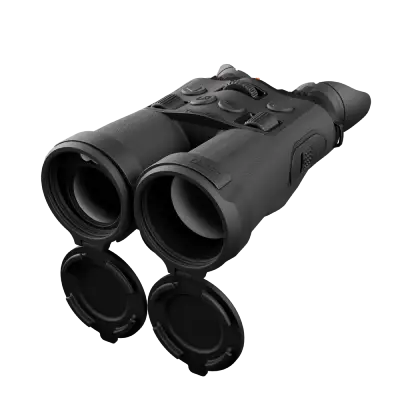
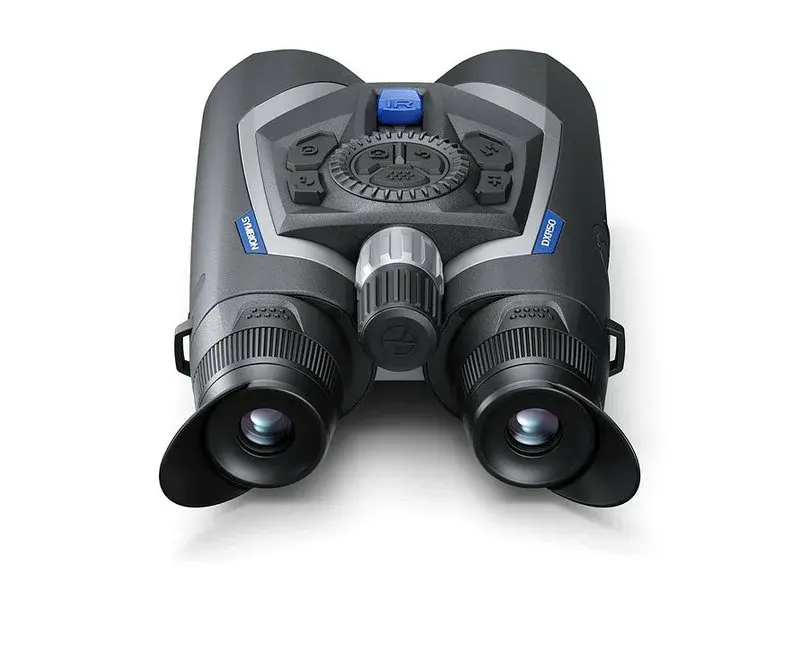
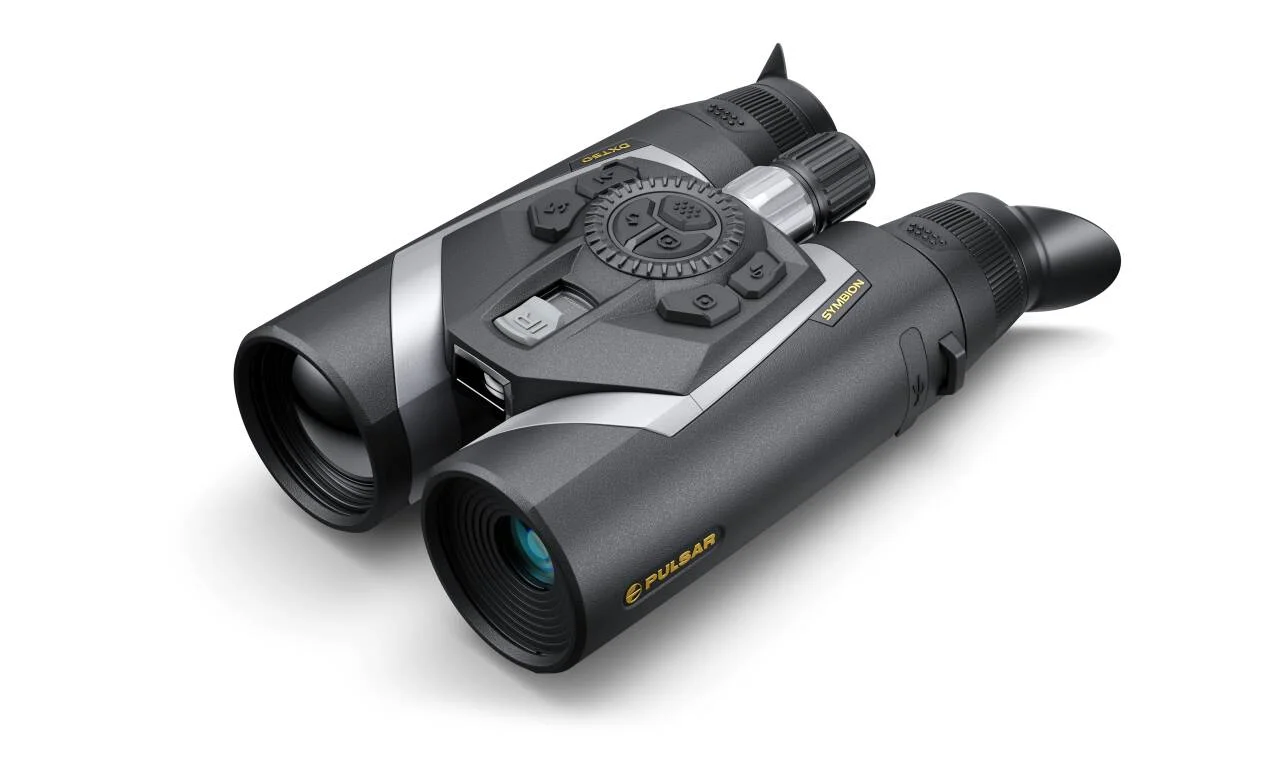
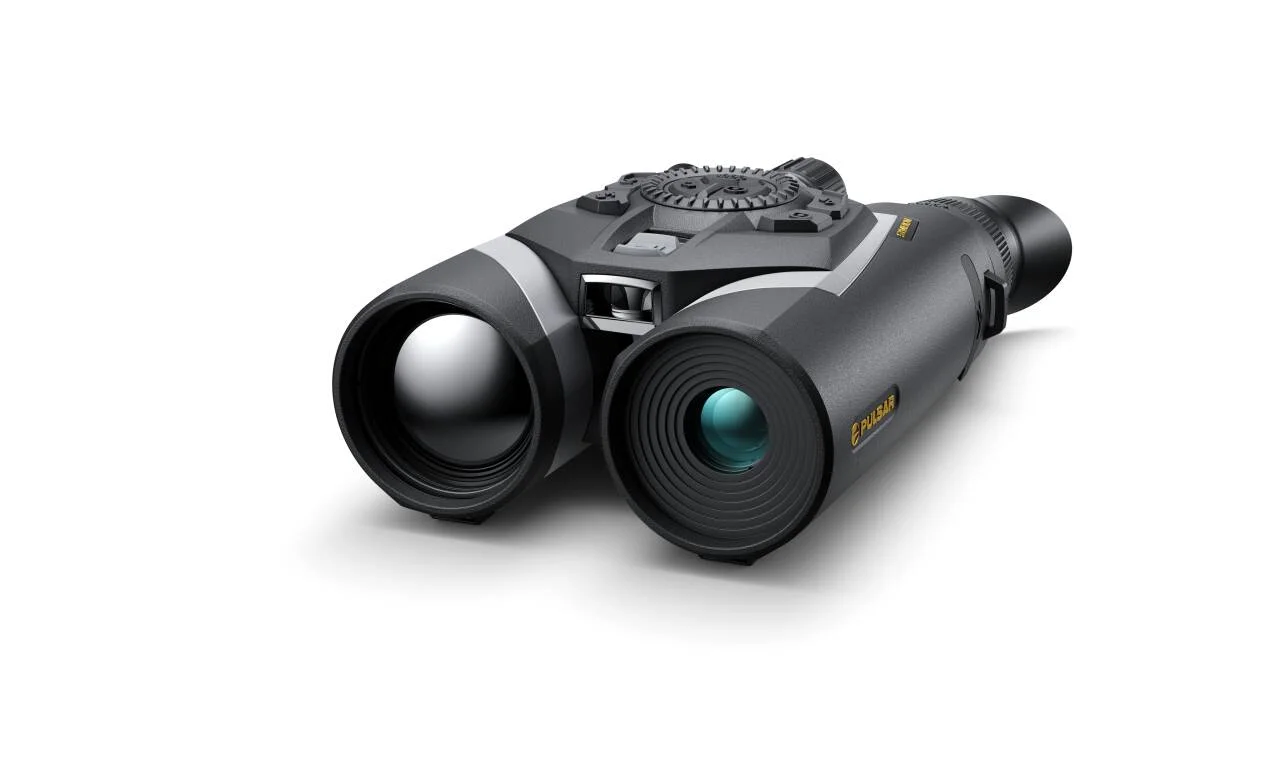
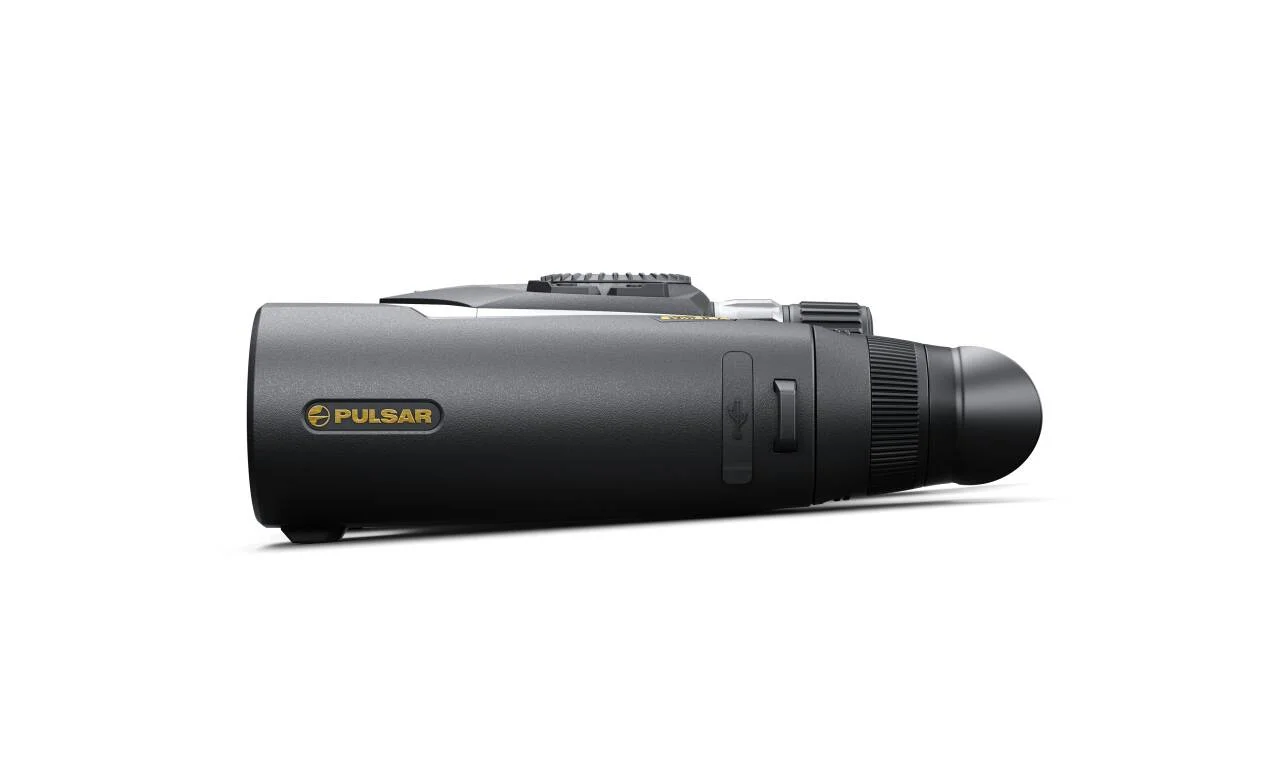
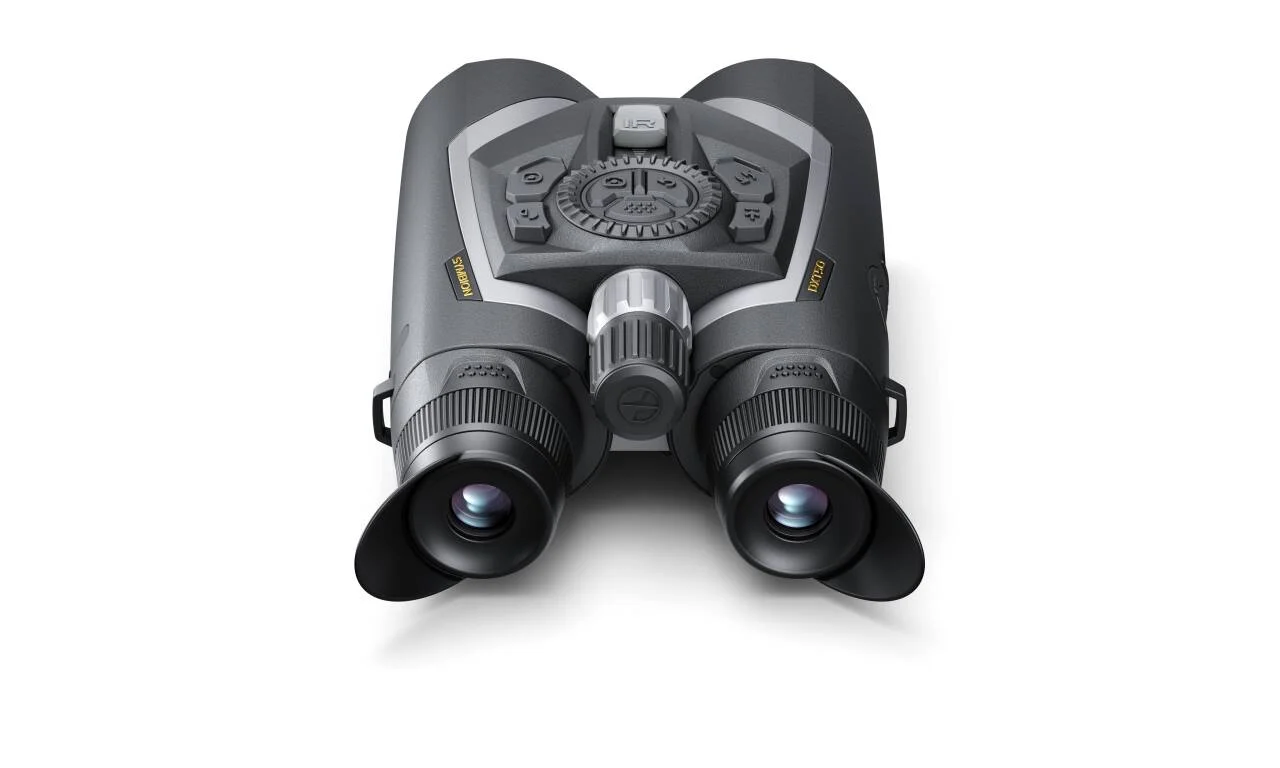
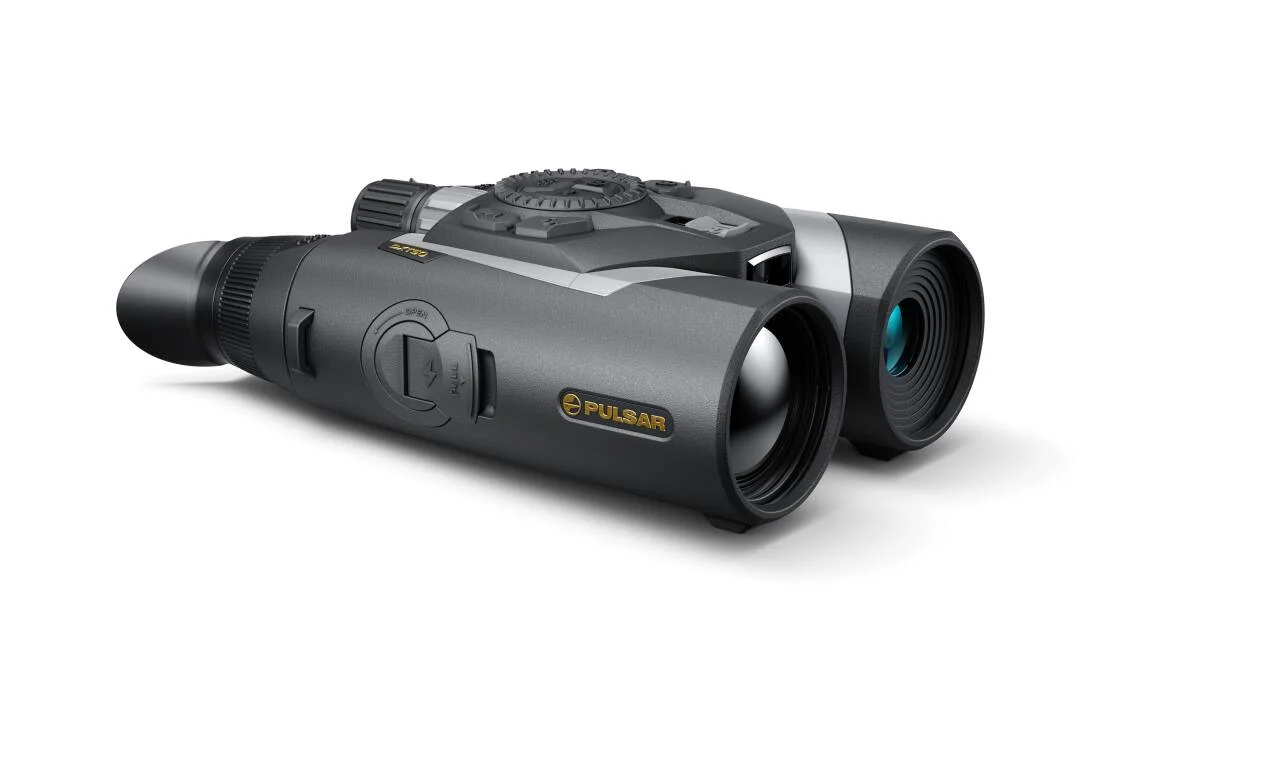
The Pulsar Symbion LRF DXT50 adopts a conventional binocular-style body with ergonomically positioned controls.
Separate focusing mechanisms are provided for the thermal and digital observation channels.
This arrangement allows the user to focus each imaging system independently.
The device includes dedicated controls for changing channels, accessing multispectral mode, operating the rangefinder, recording images and adjusting settings.
An integrated controller ring enables menu navigation and smooth zoom adjustment.
The interface also supports left-handed operation, providing flexibility for different users.
The familiar binocular configuration is suited to scanning terrain and observing distant subjects from a stationary position or while moving through the countryside.
19. Magnesium Alloy Housing and IP67 Protection
Built for outdoor field conditions
The Symbion LRF DXT50 uses a magnesium alloy housing, combining a rigid structure with a practical binocular form factor.
The enclosure is designed to withstand normal outdoor demands, including exposure to wet conditions, dust and changing temperatures.
Its IP67 protection rating indicates a dust-tight construction and protection against temporary water immersion under the conditions defined by the relevant standard.
This helps protect internal electronics during observation in rain, wet vegetation and dusty environments.
The device is designed for operation across a wide temperature range, supporting use during cold-weather observation and warmer outdoor conditions.
Dimensions and weight
The binoculars measure approximately 207 × 132 × 72.5 mm and weigh around 1 kg with the battery installed.
A carrying harness and neck strap provide options for transporting the device during extended observation sessions.
A tripod mounting interface also supports stable observation from a fixed position.
20. Dual APS5 Rechargeable Battery System
Extended operation and replaceable power
The Pulsar Symbion LRF DXT50 uses two removable APS5 lithium-ion battery packs.
Each battery has a stated capacity of 4900 mAh.
The manufacturer specifies an operating time of up to 8 hours with two APS5 batteries at an ambient temperature of approximately 22°C.
This gives the device an extended operating capability for regular field sessions.
Actual battery endurance depends on selected imaging channels, infrared illumination, laser ranging, wireless connectivity, recording activity and temperature.
The replaceable battery arrangement enables users to carry additional compatible battery packs for longer observation periods.
USB-C external power
The device supports external power through its USB Type-C connection, with 5 V and 9 V Power Delivery compatibility.
A suitable external power bank provides an additional option for longer observation sessions or charging requirements.
21. Intelligent Power Management
Reduce unnecessary battery consumption
The Symbion DXT50 includes a proximity sensor designed to manage display operation automatically.
When the binoculars are moved away from the user’s face, the displays can switch off to reduce unnecessary power consumption.
When the device is brought back into the viewing position, the displays can reactivate.
This feature is especially useful during repeated observation sessions where the binoculars are frequently lowered between scans.
Additional power management options include sleep mode, automatic shutdown settings and configurable power-saving functions.
These features help balance device availability with battery endurance.
22. Hunting and Wildlife Observation Applications
Woodland observation
The wide thermal field of view helps users scan woodland edges, clearings and areas containing mixed vegetation.
Thermal imaging assists in locating heat signatures, while digital imaging provides further visible detail when conditions permit.
Open-field scanning
The 2300 m manufacturer-rated thermal detection capability and 1500 m laser rangefinder are useful when monitoring large open areas.
The system helps observers locate distant heat sources and establish distances to suitable targets.
Dawn and dusk observation
During low-light periods, the thermal channel maintains heat-based detection while the digital twilight mode supports visual observation using remaining ambient light.
Nighttime wildlife monitoring
The thermal channel operates without visible illumination. The digital night vision channel can be supported by the integrated 850 nm infrared illuminator.
This enables different observation methods according to the level of detail required.
Conservation and wildlife management
The device is suitable for supporting animal monitoring, wildlife surveys and outdoor conservation activities.
Its multispectral capability helps users compare thermal detection with digital visual information.
Search and outdoor observation
Thermal imaging can assist in locating warm subjects in difficult lighting conditions, while the digital channel helps provide additional environmental context.
Results depend on visibility, temperature differences and intervening obstacles.
23. Why Choose the Pulsar Symbion LRF DXT50?
The Pulsar Symbion LRF DXT50 brings several advanced observation technologies together in one handheld binocular platform.
Its 1280×1024 thermal sensor delivers a high level of native thermal detail, while the 4K digital sensor provides full-colour observation and infrared-assisted night vision.
The wide thermal field of view supports efficient scanning, and the laser rangefinder adds useful distance information without requiring separate equipment.
Electronic stabilisation, integrated recording, wireless connectivity and a weather-resistant magnesium alloy body further extend the device’s practical capabilities.
For users who need to locate heat signatures, examine distant subjects and alternate between thermal and conventional digital observation, the Symbion DXT50 offers a comprehensive multispectral solution.
Pulsar Symbion LRF DXT50 combines high-resolution thermal imaging, 4K digital vision, precision distance measurement and adaptable observation modes in one field-ready binocular system
| Specification | Symbion LRF DXT50 | Symbion LRF DXR50 |
|---|---|---|
| GENERAL | ||
| Manufacturer | Pulsar | Pulsar |
| Model | DXT50 | DXR50 |
| SKU | 77456 | 77458 |
| Device type | Multispectral binoculars | Multispectral binoculars |
| THERMAL SENSOR | ||
| Sensor technology | Uncooled microbolometer | Uncooled microbolometer |
| Resolution | 1280 × 1024 | 640 × 480 |
| Thermal sensor pixels | 1,310,720 | 307,200 |
| Pixel pitch | 12 µm | 12 µm |
| Sensor NETD | <35 mK | <35 mK |
| System NETD | <20 mK | <18 mK |
| Frame rate | 50 Hz | 50 Hz |
| THERMAL OPTICS | ||
| Objective lens | 50 mm F1.0 | 50 mm F1.0 |
| Magnification | 2–24x | 4–32x |
| Base magnification | 2x | 4x |
| Horizontal field of view | 17.5° | 8.8° |
| Field of view at 100 m | 30.7 m | 15.4 m |
| Thermal detection range | 2300 m | 2300 m |
| Electronic image stabilisation | Yes | Yes |
| DIGITAL IMAGING | ||
| Sensor | 4K CMOS | 4K CMOS |
| Digital resolution | 3840 × 2160 | 3840 × 2160 |
| Digital lens | 50 mm F1.8 | 50 mm F1.8 |
| Digital magnification | 6.5–26x | 6.5–26x |
| Digital zoom | 1x, 2x, 4x | 1x, 2x, 4x |
| Digital field of view | 5.8° | 5.8° |
| Digital FOV at 100 m | 10.2 m | 10.2 m |
| Minimum focusing distance | 3 m | 3 m |
| Thermal/digital DUO | Yes | Yes |
| Multispectral PiP | Yes | Yes |
| INFRARED ILLUMINATOR | ||
| Illuminator type | LED | LED |
| IR wavelength | 850 nm | 850 nm |
| Adjustable IR beam | Yes | Yes |
| DISPLAY | ||
| Display technology | AMOLED | AMOLED |
| Display resolution | 1920 × 1080 | 1920 × 1080 |
| Dioptre adjustment | –5 to +5 | –5 to +5 |
| Eye relief | 13 mm | 13 mm |
| Interpupillary distance | 62.5–74 mm | 62.5–74 mm |
| LASER RANGEFINDER | ||
| Maximum range | 1500 m | 1500 m |
| Accuracy | ±1 m | ±1 m |
| Laser wavelength | 905 nm | 905 nm |
| RECORDING | ||
| Video resolution | 1440 × 1080 | 1440 × 1080 |
| Photo resolution | 1440 × 1080 | 1440 × 1080 |
| Video format | MP4 | MP4 |
| Photo format | JPG | JPG |
| Internal memory | 64 GB | 64 GB |
| Audio recording | Yes | Yes |
| CONNECTIVITY | ||
| Wi-Fi | 2.4 / 5 GHz | 2.4 / 5 GHz |
| Bluetooth | BLE 4.2 | BLE 4.2 |
| Stream Vision 2 | Yes | Yes |
| Stream Vision Ballistics | Yes | Yes |
| POWER SUPPLY | ||
| Battery type | 2 × APS5 | 2 × APS5 |
| Battery capacity | 4900 mAh each | 4900 mAh each |
| Battery operating time | Up to 8 hours | Up to 10 hours |
| External power | USB-C 5 V / 9 V | USB-C 5 V / 9 V |
| CONSTRUCTION | ||
| Housing | Magnesium alloy | Magnesium alloy |
| Waterproof rating | IP67 | IP67 |
| Operating temperature | –25°C to +40°C | –25°C to +40°C |
| Dimensions | 207 × 132 × 72.5 mm | 207 × 132 × 72.5 mm |
| Weight with battery | 1 kg | 1 kg |
| Tripod compatibility | Yes | Yes |
Pulsar Symbion LRF DXT50 vs DXR50 – Which Multispectral Binoculars Should You Choose?
The Pulsar Symbion LRF DXT50 and DXR50 are advanced multispectral binoculars designed for hunting, wildlife observation and professional outdoor applications.
Both models combine thermal imaging, 4K digital day and night vision, an integrated 1500 m laser rangefinder, electronic image stabilisation and multispectral Picture-in-Picture technology.
Although they share the same binocular platform, the two models offer different thermal imaging characteristics.
The DXT50 prioritises maximum thermal image resolution and wide-area scanning, while the DXR50 focuses on higher magnification, narrower-field observation and extended battery operation.
1. Thermal Image Resolution – DXT50 Advantage
The most significant difference is the thermal sensor resolution.
The Symbion DXT50 features a 1280×1024 thermal sensor, delivering 1,310,720 thermal pixels.
The DXR50 uses a 640×480 thermal sensor, providing 307,200 thermal pixels.
The DXT50 therefore contains approximately 4.27 times more thermal sensor pixels.
This higher native resolution provides greater potential for capturing fine thermal details, examining animal outlines and maintaining useful image information during digital magnification.
For users who prioritise detailed thermal imaging and scanning mixed terrain, the DXT50 offers a substantial resolution advantage.
2. Field of View – DXT50 Advantage
The DXT50 provides a horizontal thermal field of view of 30.7 metres at 100 metres.
The DXR50 offers 15.4 metres at the same distance.
This means the DXT50 covers approximately twice the horizontal width of the DXR50 during observation at base magnification.
Its wider field of view makes the DXT50 particularly suitable for scanning woodland, observing moving wildlife and searching large areas without repeatedly repositioning the device.
The DXR50 provides a narrower view, concentrating observation on a smaller section of the landscape.
3. Magnification – DXR50 Advantage
The DXR50 starts at 4x thermal magnification and reaches a maximum of 32x.
The DXT50 starts at 2x and reaches up to 24x according to Pulsar’s current online specifications.
The higher base magnification of the DXR50 presents distant subjects at a larger apparent size immediately, making it well suited to observing individual objects in open terrain.
The DXT50 begins with a wider view and lower magnification, making it more convenient for locating heat signatures before examining them in greater detail.
Higher magnification does not automatically mean higher image resolution. The DXT50 retains a significant advantage in native thermal pixel count.
4. Thermal Sensitivity – DXR50 Advantage
Both models have a sensor NETD specification below 35 mK.
However, their system NETD ratings differ.
The DXT50 is rated below 20 mK, while the DXR50 achieves below 18 mK.
This gives the DXR50 a slightly stronger specified system thermal sensitivity rating.
The difference can be relevant when observing scenes with small temperature variations, although actual image performance also depends on environmental conditions and image processing.
5. Detection Range – Equal Performance Rating
Both the DXT50 and DXR50 have a manufacturer-rated thermal detection range of up to 2300 metres for a deer-sized object.
Despite the differences in thermal resolution and magnification, neither model has a higher published maximum detection distance.
The practical distinction is how each device presents the detected subject.
The DXT50 offers a wider view with greater native thermal resolution, while the DXR50 provides higher base magnification for distance-focused observation.
6. Digital Day and Night Vision – Equal Specifications
Both binoculars feature a 3840×2160 4K CMOS digital sensor, 50 mm digital objective lens and 6.5–26x digital magnification.
Their digital observation capabilities are therefore closely matched.
Each model supports daytime colour observation, twilight viewing and infrared-assisted night vision using an integrated 850 nm illuminator.
Both also provide DUO multispectral viewing, allowing thermal and digital channels to appear simultaneously through Picture-in-Picture.
7. Laser Rangefinder – Equal Specifications
Both models include an integrated laser rangefinder with a maximum measurement range of 1500 metres.
The stated ranging accuracy is ±1 metre under suitable conditions.
This enables distance measurement directly through the binoculars without requiring a separate rangefinding device.
8. Battery Life – DXR50 Advantage
The Symbion DXT50 offers up to 8 hours of operating time using two APS5 batteries.
The DXR50 extends the manufacturer-rated battery life to 10 hours with the same battery system.
This represents a 25% increase in specified runtime.
The DXR50 therefore provides an advantage for extended observation sessions where access to additional batteries or charging is limited.
Actual operating time depends on infrared illumination, wireless connectivity, recording, ranging activity and the active observation channels.
9. Which Symbion Model Is Better for Hunting?
Choose the Pulsar Symbion LRF DXT50 if you prioritise:
- Maximum native thermal image resolution.
- A wide field of view for searching large areas.
- Scanning woodland and mixed landscapes.
- Locating and tracking moving wildlife.
- Greater thermal image detail across the observed scene.
Choose the Pulsar Symbion LRF DXR50 if you prioritise:
- Higher base thermal magnification.
- Distance-focused observation in open terrain.
- A narrower field of view for examining individual subjects.
- Slightly stronger specified system thermal sensitivity.
- Longer battery operating time.
Final Comparison
The Pulsar Symbion LRF DXT50 is the stronger choice for users seeking maximum thermal resolution and wide-area scanning performance.
The Pulsar Symbion LRF DXR50 is better suited to observers who prefer higher initial magnification, focused long-distance viewing and extended battery endurance.
Both models deliver the same manufacturer-rated 2300 m thermal detection distance and share advanced 4K digital imaging, multispectral DUO observation and a built-in 1500 m laser rangefinder.


Reviews
There are no reviews yet.