

Description
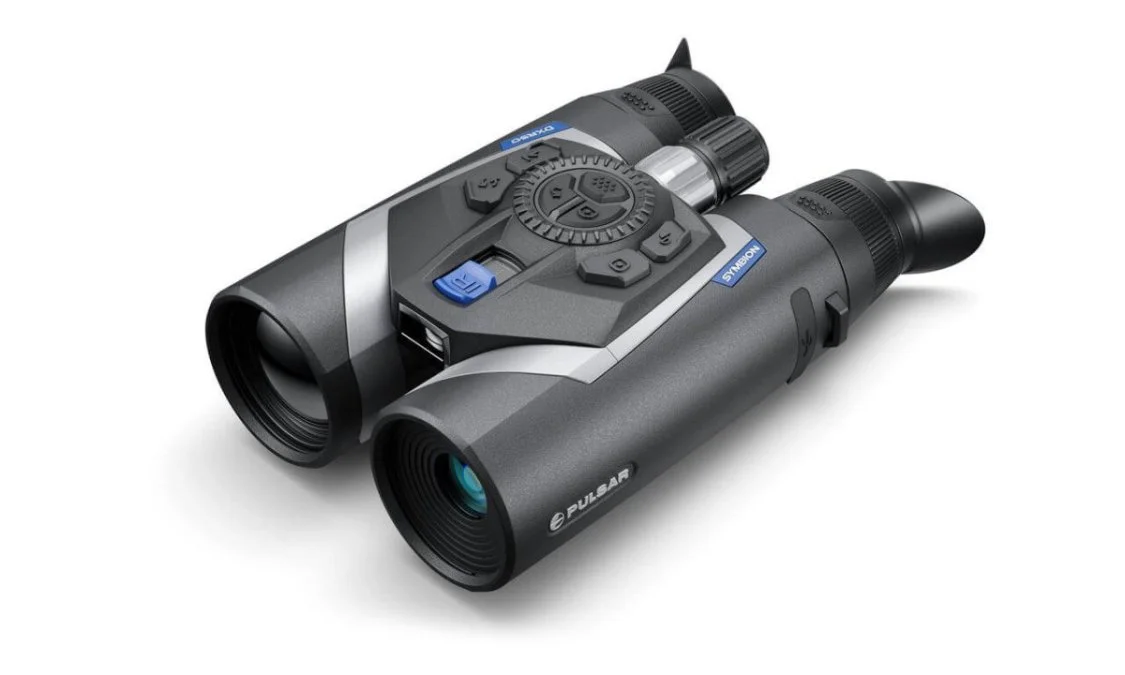
Pulsar SYMBION LRF DXR50 – 4K Multispectral Thermal Imaging Binoculars with 1500m Laser Rangefinder
Advanced Thermal Imaging, 4K Day & Night Vision and Long-Range Observation in One Device
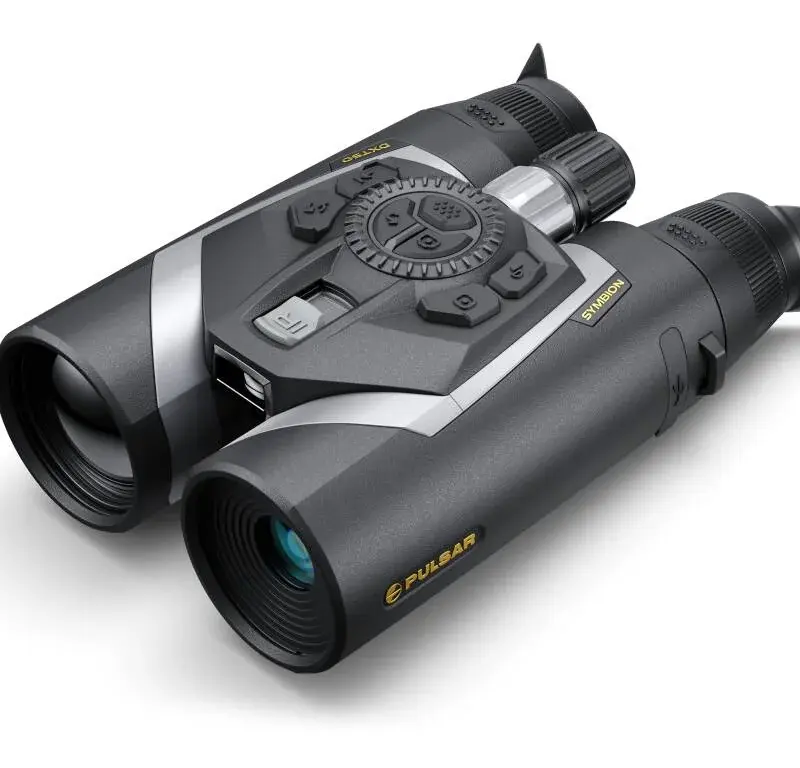
The Pulsar SYMBION LRF DXR50 is a multispectral thermal imaging binocular designed for hunters, wildlife observers and outdoor professionals who require accurate detection, detailed observation and reliable distance measurement in changing conditions.
Combining a high-sensitivity 640 × 480 thermal imaging sensor, a 4K digital CMOS sensor, integrated night vision, an 850nm infrared illuminator and a 1500-metre laser rangefinder, the DXR50 offers a comprehensive observation system for both daytime and nighttime applications.
Its powerful 50mm thermal objective lens, 4–32x thermal magnification and detection range of up to 2300 metres make the DXR50 particularly suitable for observing distant animals across open fields, agricultural land and large hunting areas.
Unlike conventional thermal binoculars, which display temperature differences without natural visual detail, the SYMBION DXR50 allows users to switch between thermal detection and high-resolution digital observation.
The result is greater flexibility when locating animals, examining their surroundings and assessing distances before making decisions in the field.
Main Features of the Pulsar SYMBION LRF DXR50
- 640 × 480 high-sensitivity thermal sensor with 12µm pixel pitch
- 3840 × 2160 4K digital CMOS sensor for daytime and nighttime observation
- 50mm F1.0 thermal objective lens
- 50mm F1.8 digital objective lens
- 2300m maximum thermal detection range
- 4–32x thermal magnification
- 6.5–26x digital magnification
- System NETD below 18mK
- 1920 × 1080 AMOLED display
- Built-in laser rangefinder with a maximum measuring distance of 1500m
- Integrated 850nm focusable infrared illuminator
- Multispectral Picture-in-Picture observation
- Electronic image stabilisation
- Photo and video recording with sound
- 64GB internal memory
- Dual-band 2.4GHz and 5GHz Wi-Fi
- Stream Vision 2 and Stream Vision Ballistics compatibility
- Integrated ballistic calculator
- Two interchangeable APS5 rechargeable batteries
- Up to 10 hours of operating time under specified conditions
- Magnesium alloy housing with IP67 protection
640 × 480 Thermal Imaging Sensor – Reliable Detection in Challenging Conditions
At the heart of the Pulsar SYMBION LRF DXR50 is an uncooled thermal microbolometer with a resolution of 640 × 480 pixels and a 12µm pixel pitch.
This thermal imaging sensor detects differences in infrared radiation emitted by objects, animals and the surrounding environment.
The technology allows users to locate heat signatures without relying on visible light.
The DXR50 is particularly effective for detecting animals in darkness, observing activity around woodland edges and searching across large areas where conventional optical binoculars become ineffective.
High Thermal Sensitivity – System NETD Below 18mK
The DXR50 features a thermal sensor NETD below 35mK and a system NETD below 18mK.
NETD, or Noise Equivalent Temperature Difference, indicates the ability of a thermal imaging system to distinguish small temperature variations.
Lower NETD values indicate greater thermal sensitivity.
With a system NETD below 18mK, the SYMBION DXR50 is designed to preserve subtle temperature differences within the observed scene.
This helps improve the separation of animals from their surroundings, particularly when the temperature difference between a subject and the background is limited.
The benefits are especially relevant during humid evenings, early mornings and changing weather conditions.
50Hz Thermal Image Refresh Rate
The 50Hz frame rate provides smooth thermal image updates when observing moving animals or scanning the landscape.
This improves viewing comfort and helps users follow movement across the field of view.
Powerful 50mm F1.0 Thermal Objective Lens
The DXR50 features a 50mm F1.0 germanium objective lens designed to deliver infrared radiation efficiently to the thermal sensor.
The combination of a 50mm lens and a 12µm thermal sensor produces a relatively narrow field of view with strong base magnification.
This optical configuration is particularly useful for observing distant objects across open terrain.
4–32x Thermal Magnification
The thermal channel offers magnification from 4x to 32x.
At its native 4x magnification, the binocular provides a detailed view of distant thermal signatures.
Digital magnification allows users to examine selected objects more closely.
Higher magnification is particularly useful for examining distant animals or individual areas of the landscape, although digital zoom does not add physical sensor detail.
Thermal Field of View
The thermal field of view measures:
- 8.8 degrees horizontally
- 15.4 metres at a distance of 100 metres
This narrower field of view prioritises the observation of distant subjects rather than scanning large areas at close range.
For hunters operating in open countryside, agricultural fields and extensive hunting grounds, the DXR50 provides an optical configuration suited to longer-distance observation.
Thermal Detection Range Up to 2300 Metres
The Pulsar SYMBION LRF DXR50 offers a stated thermal detection range of up to 2300 metres for a deer-sized object.
This allows users to detect a suitable thermal signature at considerable distances under favourable conditions.
Thermal detection should not be confused with animal identification.
Detection indicates that a heat-emitting object is present, while recognising its species and examining identifying details generally requires closer observation.
Actual performance depends on atmospheric conditions, temperature contrast, vegetation, target size and other environmental factors.
The DXR50 combines long-range thermal detection with a separate 4K digital channel to support more detailed observation when conditions permit.
4K Digital CMOS Sensor – Detailed Daytime and Twilight Observation
In addition to its thermal imaging system, the DXR50 integrates a 3840 × 2160-pixel digital CMOS sensor.
This 4K digital imaging channel provides an alternative to thermal observation when users need to examine visible details.
During daylight, it produces full-colour images suitable for studying terrain, identifying landmarks and observing wildlife.
In twilight conditions, the digital channel offers additional opportunities to examine animals and their surroundings.
For nighttime observation, the integrated infrared illuminator supports black-and-white digital viewing.
Digital Optical System
The digital channel features:
- Sensor resolution: 3840 × 2160 pixels
- Objective lens: 50mm F1.8
- Magnification: 6.5–26x
- Horizontal field of view: 5.8 degrees
- Field of view at 100 metres: 10.2 metres
The high base magnification makes the digital channel particularly suitable for examining subjects at a distance.
Why Combine Thermal and Digital Imaging?
Thermal imaging and digital imaging provide different types of information.
Thermal imaging is used primarily to reveal heat signatures and locate objects in darkness or visually difficult environments.
Digital imaging is designed to provide visible structural details, colours during daylight and high-contrast black-and-white observation at night with infrared assistance.
By incorporating both technologies, the DXR50 allows users to select the most suitable observation method for the situation.
Built-In 850nm Infrared Illuminator for Night Vision
The SYMBION LRF DXR50 incorporates an 850nm infrared LED illuminator.
Unlike thermal imaging, digital night vision depends on available or artificial infrared illumination when ambient light is insufficient.
The integrated illuminator provides additional infrared light for the digital channel, allowing observation in dark environments.
The illuminator features adjustable focusing and three power levels.
Users can adapt the illumination to the distance and conditions of the observation area.
This feature is useful when examining details that cannot be established using the thermal image alone.
Multispectral Picture-in-Picture – Thermal and Digital Imaging Together
One of the DXR50’s most useful functions is its multispectral Picture-in-Picture capability.
The system allows users to display information from both the thermal and digital imaging channels at the same time.
One image appears as the primary observation view, while the second channel appears in a smaller window.
For example, a hunter can locate an animal using thermal imaging while viewing the digital image to examine the visible surroundings.
This reduces the need to repeatedly switch between observation systems.
The feature supports faster interpretation of complex scenes, particularly when distinguishing between animals, vegetation and background objects.
Electronic Image Stabilisation
High magnification makes even small hand movements more noticeable.
The SYMBION DXR50 includes electronic image stabilisation designed to reduce the visible effects of hand movement.
This helps maintain a steadier image when observing distant animals or using higher magnification.
Image stabilisation is particularly valuable during extended handheld observation, when a tripod is unavailable or impractical.
The function also supports more comfortable tracking of moving subjects.
Integrated 1500m Laser Rangefinder
Accurate distance measurement is an important part of wildlife observation and hunting.
The Pulsar SYMBION DXR50 incorporates a laser rangefinder capable of measuring distances up to 1500 metres.
Laser Rangefinder Specifications
- Maximum measuring distance: 1500 metres
- Measurement accuracy: ±1 metre
- Laser wavelength: 905nm
- Laser safety classification: Class 1
- Single measurement and continuous scanning modes
The rangefinder allows users to determine the distance to an observed object without carrying a separate measuring device.
Continuous scanning is useful when examining several objects across a landscape or following movement.
The binocular also supports true horizontal distance indication, providing additional information when observing targets at an angle.
Range measurement performance depends on target reflectivity, object size and environmental conditions.
Integrated Ballistic Calculator and Connectivity
The DXR50 supports ballistic calculation features through its integrated software and compatibility with Stream Vision Ballistics.
This allows the device to form part of a broader observation and ballistic data workflow.
The system also supports compatible external ballistic information.
For hunters who already work with Pulsar equipment and software, this connectivity helps bring observation and range measurement information into one system.
Full HD AMOLED Display
The Pulsar SYMBION DXR50 features a 1920 × 1080 AMOLED display system.
The high-resolution display provides detailed image reproduction for both the thermal and digital observation channels.
AMOLED technology delivers strong contrast, deep black levels and clear separation between bright and dark areas.
This is useful for interpreting fine temperature differences in thermal mode and studying visible detail through the digital channel.
The binocular also provides adjustable display settings to suit observation conditions and personal preferences.
Photo and Video Recording with Sound
The SYMBION LRF DXR50 includes an integrated recording system for capturing observation sessions.
Users can photograph animals, record video sequences and document activity without attaching an external camera.
Recording Specifications
- Video resolution: 1440 × 1080 pixels
- Photo resolution: 1440 × 1080 pixels
- Video format: MP4
- Photo format: JPG
- Internal memory: 64GB
- Audio recording: Supported
The 64GB internal storage provides space for photographs and video recordings.
Audio recording helps document observations, environmental sounds and field activity.
Recording functions are particularly useful for wildlife monitoring, reviewing encounters and sharing footage.
Dual-Band Wi-Fi and Stream Vision 2
The DXR50 supports wireless connectivity through integrated Wi-Fi operating on both 2.4GHz and 5GHz frequencies.
The binocular is compatible with Pulsar’s Stream Vision 2 application for supported iOS and Android devices.
Through the application, users can access compatible features such as:
- Wireless image viewing
- Remote device control
- Photo and video management
- Firmware updates
- Media transfer and sharing
- Supported cloud storage functions
The device also supports Stream Vision Ballistics.
These functions extend the binocular’s capabilities beyond direct observation and provide convenient access to captured material.
Two APS5 Batteries – Up to 10 Hours of Operation
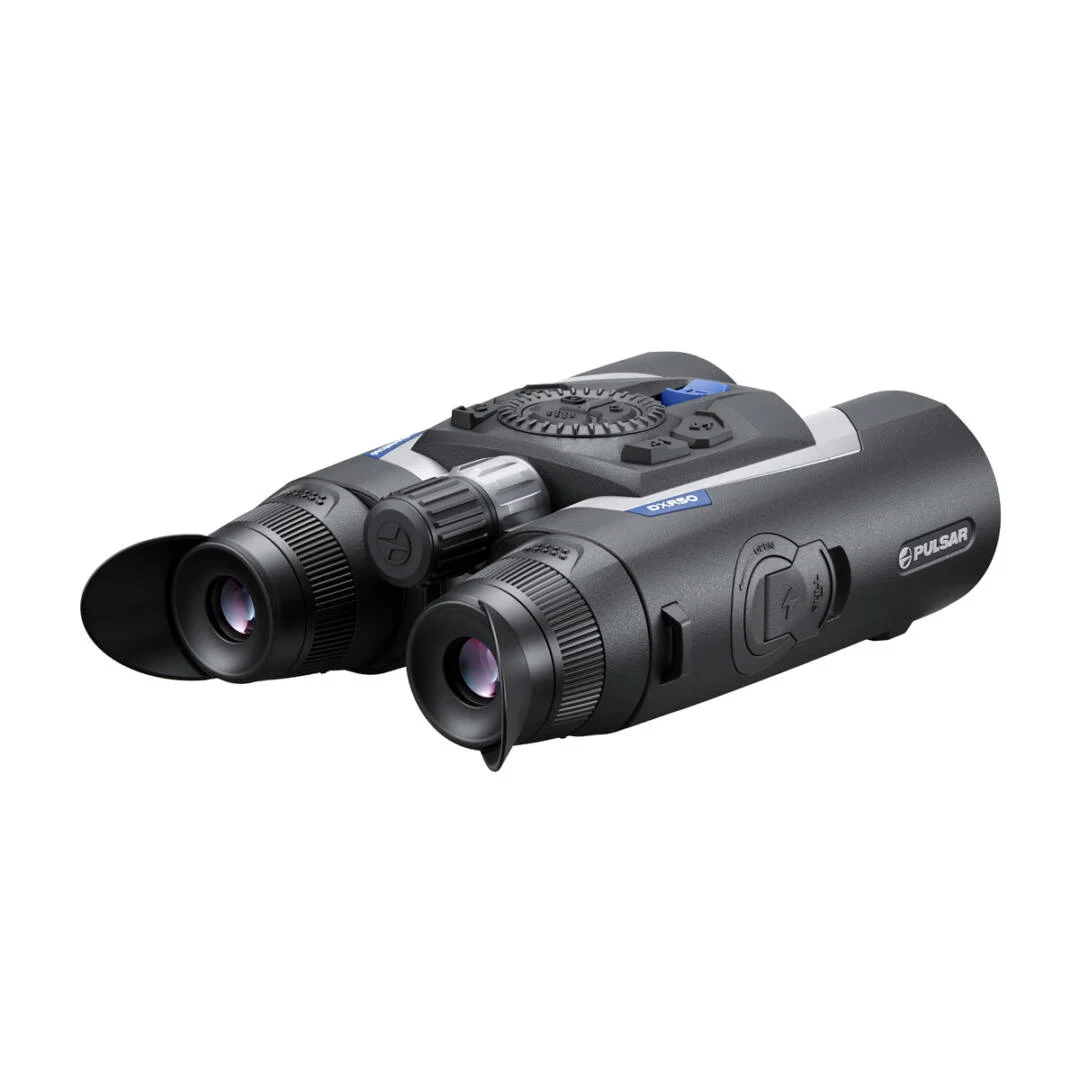
The SYMBION LRF DXR50 is powered by two removable APS5 lithium-ion rechargeable batteries.
Each APS5 battery has a stated capacity of 4900mAh.
The manufacturer specifies up to 10 hours of operation using two APS5 batteries at an ambient temperature of 22°C.
Actual operating time depends on the activity of the thermal and digital channels, infrared illuminator, laser rangefinder, Wi-Fi, recording functions and power-saving settings.
Practical Battery Advantages
The interchangeable battery design allows users to replace depleted batteries during extended observation sessions.
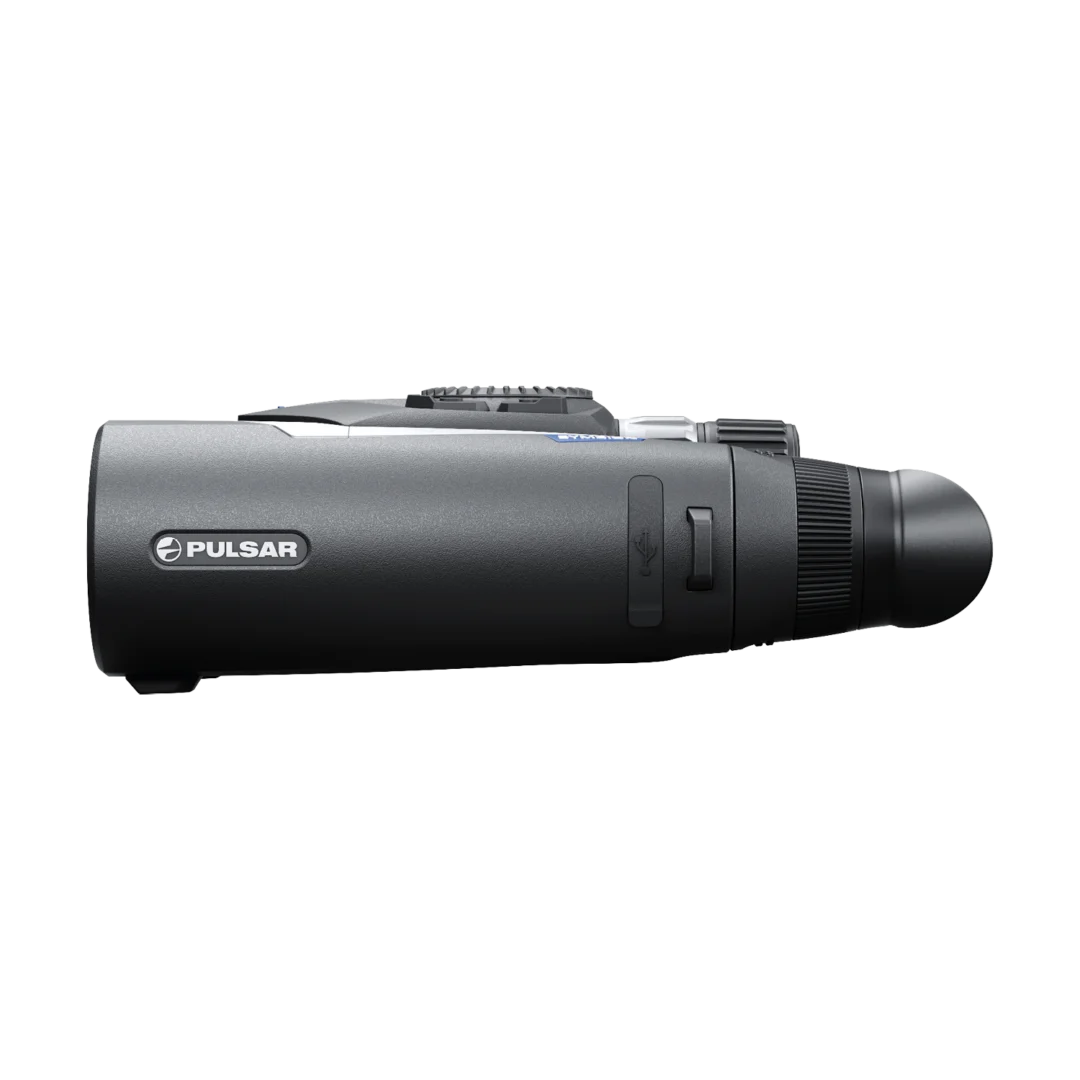
USB Type-C external power support provides an alternative power source when compatible equipment is available.
The energy-saving sleep mode helps reduce unnecessary consumption between observation periods.
Magnesium Alloy Housing and IP67 Protection
The DXR50 is built around a magnesium alloy housing designed to provide a durable structure without excessive weight.
Its IP67 protection rating indicates resistance to dust and temporary immersion in water under the conditions specified by the rating.
This construction supports outdoor operation in rain, mud, dust and challenging field environments.
Ergonomic Binocular Design
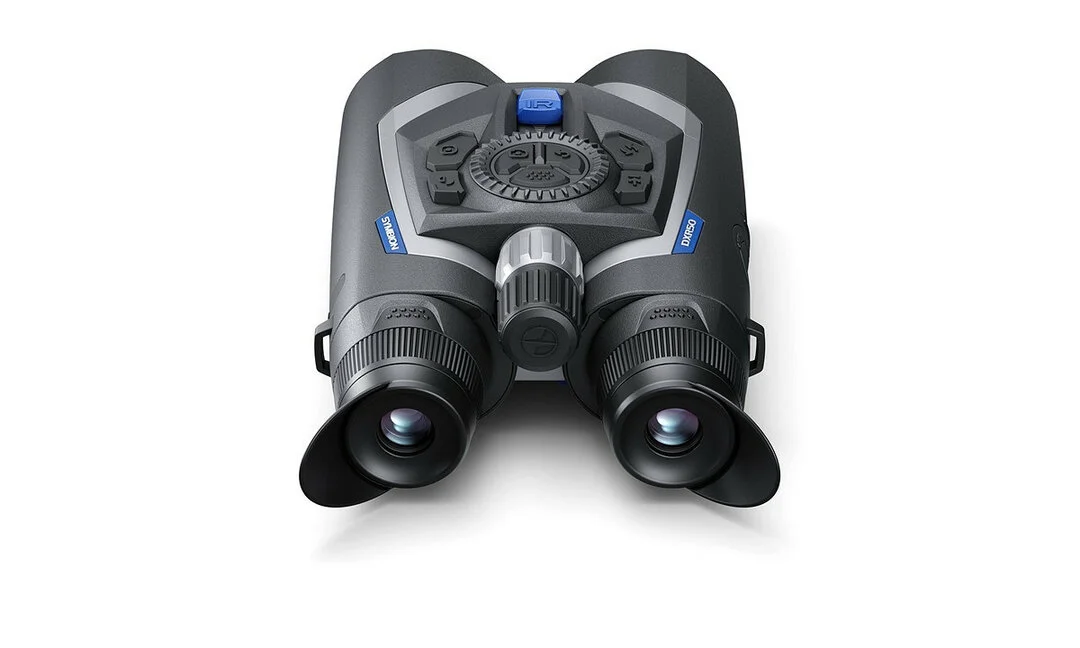
The DXR50 features a traditional binocular-style body with controls arranged for convenient operation.
Dual focusing wheels allow independent adjustment of the thermal and digital optical channels.
The binocular supports both left-handed and right-handed operation, while its tactile controls help users operate the system without constantly looking away from the observed scene.
A three-position power switch provides direct access to power and sleep functions.
Dimensions and Weight
- Dimensions: 207 × 132 × 72mm
- Weight: approximately 1kg with batteries
- Body: magnesium alloy
- Protection: IP67
- Operating temperature: -25°C to +50°C according to the product specification
Who Should Choose the Pulsar SYMBION LRF DXR50?
The DXR50 is particularly well suited to users who prioritise long-distance observation, relatively high base magnification and the convenience of combining several imaging technologies.
Open-Country Hunting
The 4x base thermal magnification and 50mm objective lens make the binocular suitable for observing animals across fields, open hillsides and agricultural land.
Wildlife Observation
The combined thermal and 4K digital channels allow wildlife observers to locate animals through heat detection and examine their visible characteristics when lighting conditions permit.
Nighttime Observation
The integrated 850nm infrared illuminator extends digital viewing into darkness, while the thermal channel remains available for detecting heat signatures without external illumination.
Professional Field Monitoring
The rangefinder, recording functions, stabilisation and multispectral viewing system support applications involving wildlife management, land monitoring and search operations.
Why Buy the Pulsar SYMBION LRF DXR50?
The Pulsar SYMBION LRF DXR50 combines thermal detection, 4K digital observation, infrared-assisted night vision and laser distance measurement in one binocular system.
Its main advantage is the ability to obtain different types of visual information without repeatedly changing equipment.
For users who spend time observing distant wildlife in changing light conditions, the DXR50 provides a practical balance between thermal sensitivity, magnification, digital detail and integrated functionality.
With its 640 × 480 thermal sensor, system NETD below 18mK, 2300m detection range and 1500m laser rangefinder, the DXR50 is designed to support demanding outdoor observation.
The magnesium housing, interchangeable batteries, image stabilisation and built-in recording system complete a device intended for regular use in the field.
Pulsar SYMBION LRF DXR50 vs SYMBION LRF DXT50 – Full Technical Comparison
Both models combine multispectral technology, 4K digital observation, infrared-assisted night vision and integrated laser distance measurement.
The main differences are in thermal sensor resolution, base magnification, field of view, system thermal sensitivity and battery runtime.
| Specification | SYMBION LRF DXR50 | SYMBION LRF DXT50 |
|---|---|---|
| Thermal sensor resolution | 640 × 480 | 1280 × 1024 |
| Thermal pixel pitch | 12µm | 12µm |
| Thermal sensor type | Uncooled microbolometer | Uncooled microbolometer |
| Sensor NETD | <35mK | <35mK |
| System NETD | <18mK | <20mK |
| Thermal objective lens | 50mm F1.0 | 50mm F1.0 |
| Thermal magnification | 4–32x | 2–24x |
| Thermal field of view | 8.8° | 17.5° |
| Thermal FOV at 100m | 15.4m | 30.7m |
| Thermal detection range | 2300m | 2300m |
| Thermal frame rate | 50Hz | 50Hz |
| Digital sensor | 4K CMOS | 4K CMOS |
| Digital resolution | 3840 × 2160 | 3840 × 2160 |
| Digital objective lens | 50mm F1.8 | 50mm F1.8 |
| Digital magnification | 6.5–26x | 6.5–26x |
| Digital field of view | 5.8° | 5.8° |
| Digital FOV at 100m | 10.2m | 10.2m |
| IR illuminator | 850nm LED | 850nm LED |
| IR power adjustment | 3 levels | 3 levels |
| Display | AMOLED | AMOLED |
| Display resolution | 1920 × 1080 | 1920 × 1080 |
| Image stabilisation | Yes | Yes |
| Multispectral Picture-in-Picture | Yes | Yes |
| Laser rangefinder | Integrated | Integrated |
| Maximum LRF range | 1500m | 1500m |
| LRF measurement accuracy | ±1m | ±1m |
| Photo/video resolution | 1440 × 1080 | 1440 × 1080 |
| Audio recording | Yes | Yes |
| Internal storage | 64GB | 64GB |
| Wi-Fi | 2.4/5GHz | 2.4/5GHz |
| Stream Vision 2 | Yes | Yes |
| Ballistic calculator | Yes | Yes |
| Battery system | 2 × APS5 | 2 × APS5 |
| Maximum stated operating time | 10 hours | 8 hours |
| Housing | Magnesium alloy | Magnesium alloy |
| Waterproof rating | IP67 | IP67 |
| Dimensions | 207 × 132 × 72mm | 207 × 132 × 72mm |
| Weight with batteries | Approx. 1kg | Approx. 1kg |
| Product SKU | 77458 | 77456 |
Which Model Is Better – DXR50 or DXT50?
Choose the SYMBION LRF DXR50 for Higher Base Magnification
The DXR50 starts at 4x thermal magnification, compared with 2x on the DXT50.
This provides a closer initial view of distant subjects.
Its narrower thermal field of view is particularly suitable for observing animals across open areas when a wide scanning view is less important.
The DXR50 also offers a slightly lower stated system NETD and a longer specified operating time.
Choose the SYMBION LRF DXT50 for Higher Thermal Resolution and Wider Observation
The DXT50 incorporates a 1280 × 1024 thermal sensor, providing approximately 4.27 times as many thermal pixels as the DXR50.
This higher sensor resolution offers substantially more thermal image information and supports more detailed observation.
Its 17.5-degree horizontal thermal field of view is almost twice as wide as that of the DXR50.
This makes the DXT50 better suited to scanning woodland, locating animals across larger sections of the landscape and following moving subjects.
Final Comparison
For users prioritising a higher initial thermal magnification and longer rated battery runtime, the DXR50 is an attractive choice.
For users seeking maximum thermal image resolution and a wider observation area, the DXT50 offers a clear technical advantage.
Both models share the same 2300m stated thermal detection range, 1500m laser rangefinder and 4K digital imaging system.


Reviews
There are no reviews yet.